Designing a Modern, Secure, and Simple VDR Experience
Summary
Finalis needed a modern, reliable, and easy-to-use Virtual Data Room that could support key stages of the deal lifecycle—from initial document exchange with clients to investor review. I redesigned the VDR end-to-end, bringing clarity, simplicity, and the right level of security, while introducing scalable foundations for future analytics and automation.
The new Finalis Data Rooms give users a simpler, faster, and more predictable way to manage and share deal materials. It streamlines permission control, supports secure collaboration across bankers, issuers, and investors, and reinforces Finalis as a trusted, safe space within the dealmaking ecosystem.
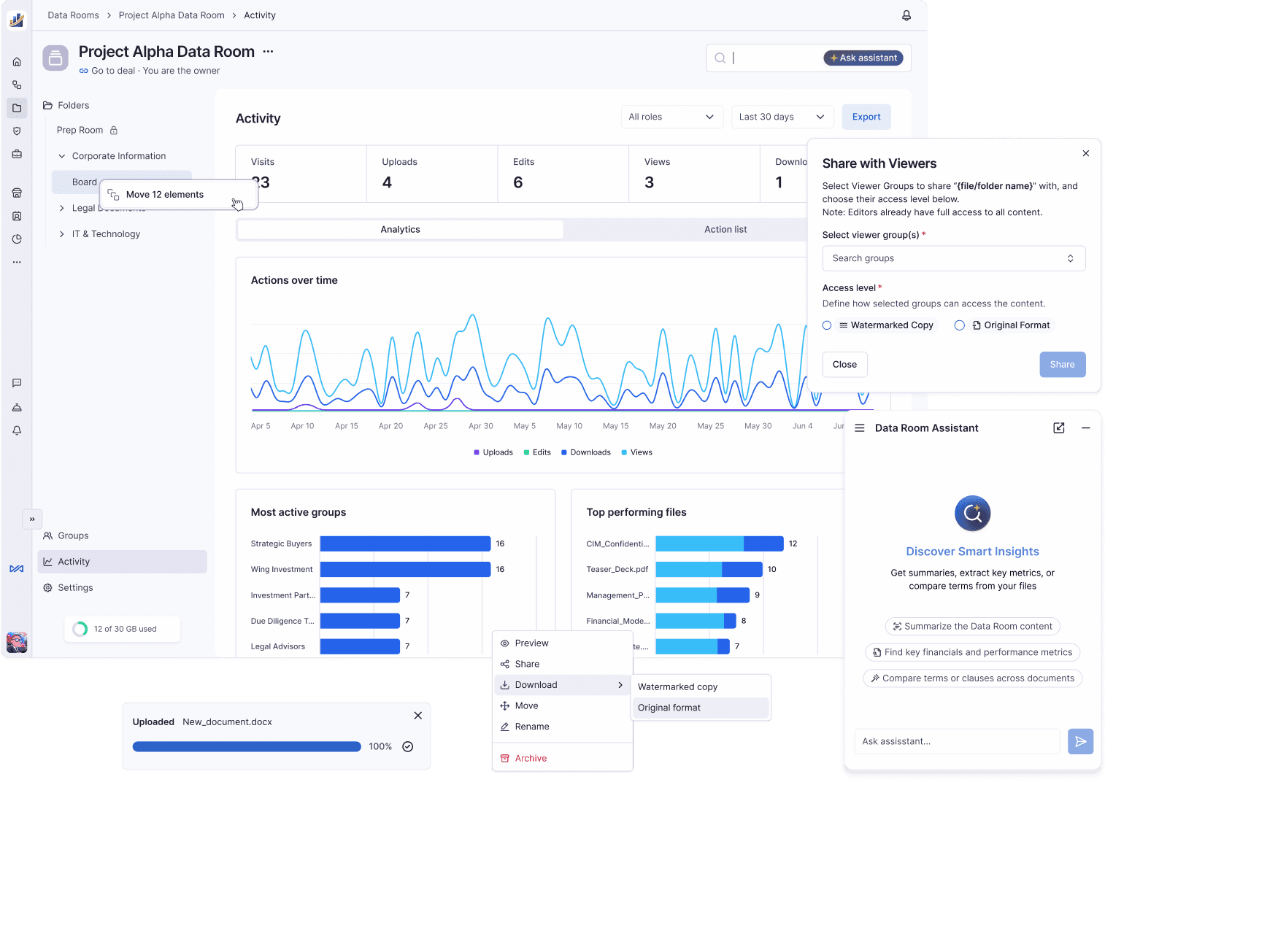
Beyond the core experience, the VDR evolved to include analytics and AI-assisted capabilities, helping admins turn activity into actionable insights and interact with documents in a more intelligent way.


Problem Framing
The existing VDR suffered from:
Outdated UI and unclear navigation
Limited security controls that did not align with user expectations
Granular permissions that were unnecessarily complex for most scenarios
No visibility into investor engagement or document activity
Frequent bugs and user complaints, especially during uploads and permission setup
Lack of alignment with real deal workflows and the needs of bankers and investors
Users relied heavily on support and workarounds. The experience didn’t match industry standards, and the tool wasn’t perceived as trustworthy by clients or investors, making adoption difficult.
Bankers & Clients
A secure, trustworthy space to manage sensitive documents
Scalable and simple permission setup for large investor groups
Visibility into investor engagement to measure interest
Investors
Fast, frictionless access to materials
The Business
A built-in VDR designed to support deal execution while avoiding unnecessary complexity
A scalable foundation for analytics and future growth
A simple experience with lower support dependency
Stronger positioning within the investment banking ecosystem
The Process
Discovery & Foundations
I consolidated existing insights, revisited past research, and analyzed competitor VDRs to understand baseline expectations. I also audited the current experience and reviewed support feedback to identify recurring friction points.
By connecting these findings with deal lifecycle insights, I aligned user needs with each stage of the transaction and defined what the VDR needed to support end-to-end.
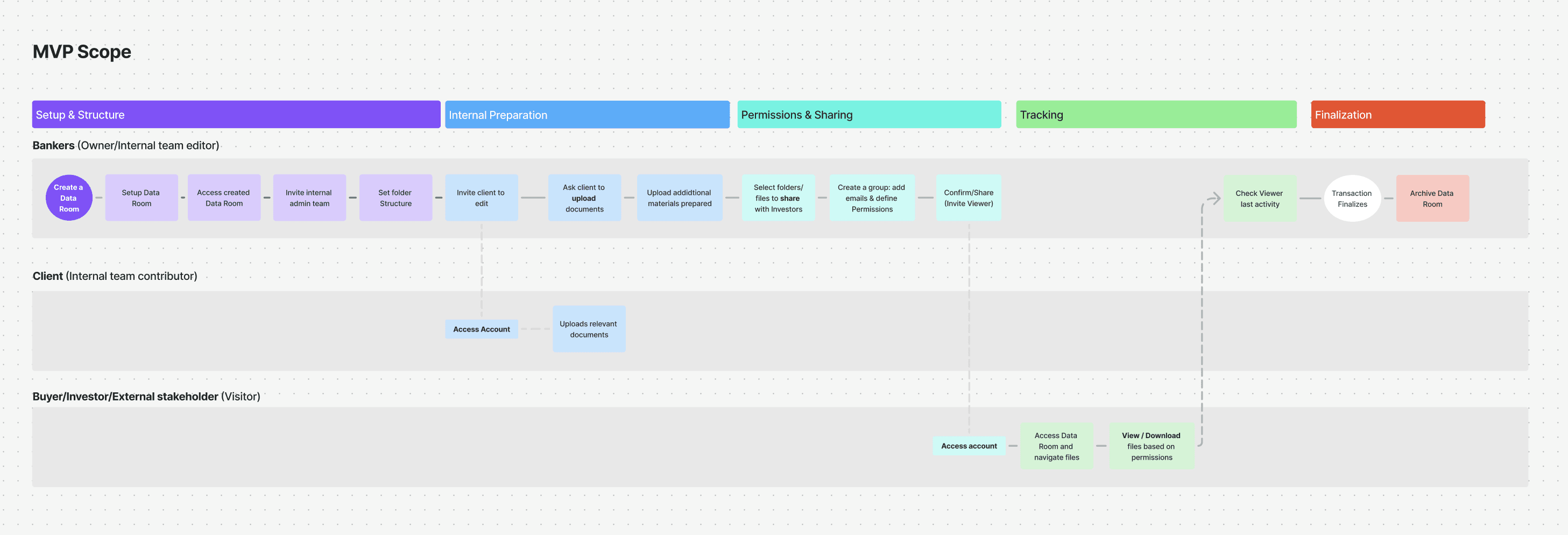
A Deal-Centered Journey
I mapped how document-sharing needs evolve throughout a transaction:
Post-engagement: Clients share initial folders and sensitive documents
Preparation & review: Bankers refine materials and collaborate internally
Investor access: Dozens of viewers may need structured, bulk permissions
Interest measurement: Engagement becomes a key signal for deal progress
This journey became the backbone of the VDR redesign.
Approach
1. Define the Core MVP
Given the urgency, we focused on delivering a version that felt modern, simple, and reliable, covering essential VDR capabilities without unnecessary complexity, and creating a structure that could scale later.
2. Simplify Roles and Permissions
Most users don’t need complex matrices, so we reduced everything to three clear roles: Admin, Editors, Viewers.
For file-level permissions, we opted for practical security rather than heavy restrictions that modern tools can easily bypass:
Watermarks with the viewer’s email
One private folder for preparation that viewers can't access (Prep-room)
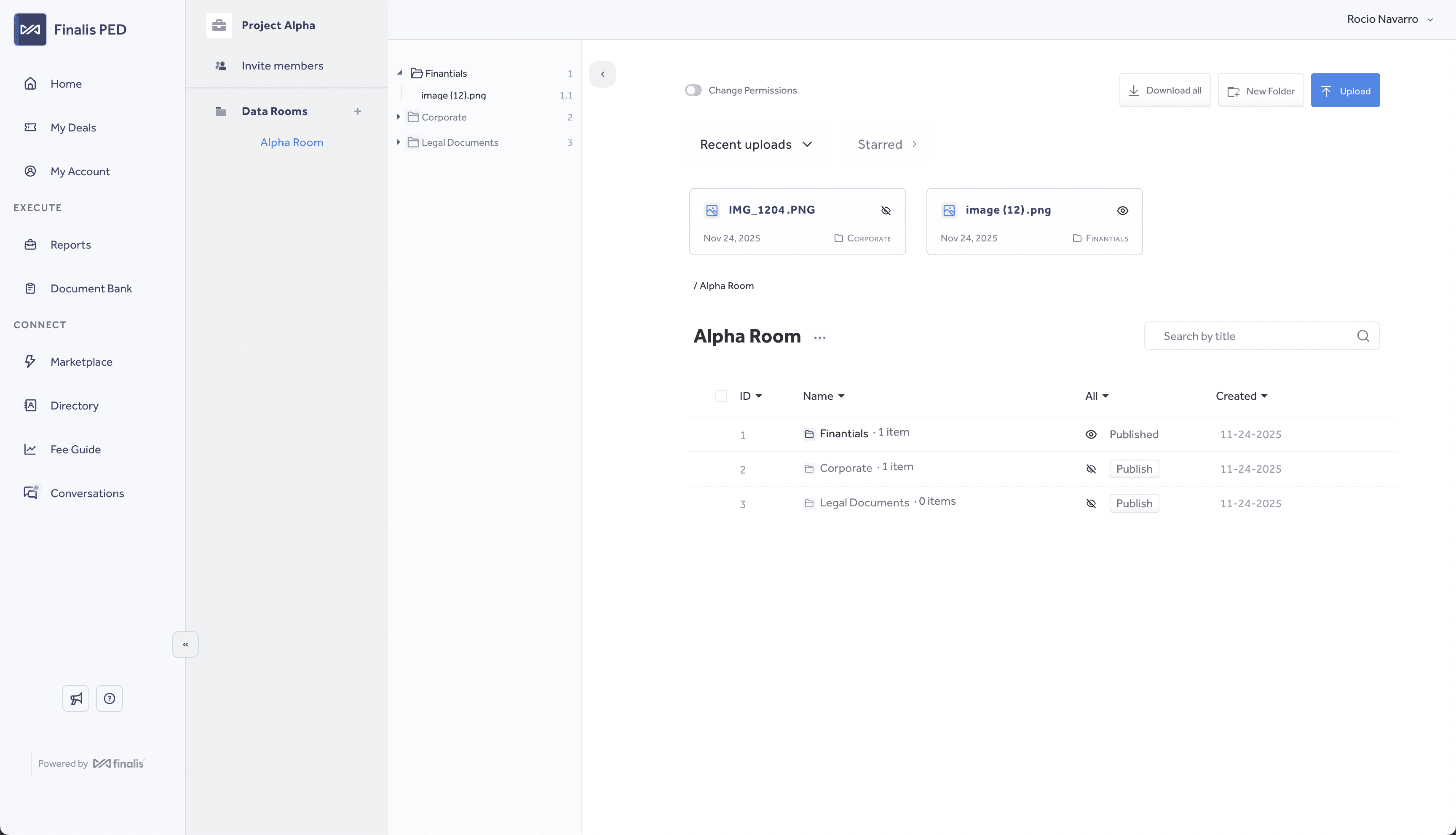
Bulk permissioning via investor groups
3. Build a Clear Document Structure
Introduced a structured tree view to help users handle large document sets.
A default Pre-Room folder provides:
A private space for internal prep
A future-ready spot to sync approved deal documents automatically
4. Introduce Basic Activity Tracking
To help users meassure investor interest, the MVP tracks: Logins, Sign-ups, File views This creates a foundation for future dashboards, heatmaps, and engagement insights.
The Outcome
A Simpler, More Trustworthy VDR
The new Finalis Data Rooms is intentionally simple, easy to use, secure enough for sensitive materials, and efficient for both small and large groups of stakeholders. It was designed with a mobile-first approach, ensuring a fully responsive experience across devices. Key improvements:
Clear roles with predictable permissions
A structured document tree
Group-based sharing for large investor lists
Watermarking to increase perceived security
Activity tracking foundation
New Chapter
From Data to Insights
After testing the MVP, we identified two key opportunities:
making activity data actionable, and helping admins quickly access and validate information across documents.

This is a quick prototype based on the Figma design, built to showcase interactions, animations, and transitions. Give it a try!
We evolved the VDR in two directions:
-> Turning activity into insight
The activity log became an analytics layer that surfaces engagement patterns. Admins can now identify active investors, track interest over time, and detect high-impact documents, enabling more informed follow-ups throughout the deal lifecycle.
->Turning documents into answers
We introduced an AI-assisted, conversational layer that allows admins to query multiple documents at once. This helps quickly find, validate, and organize information, making it easier to respond to investor questions and ensuring materials are clear and interpretable.
This also serves as an early step toward a more robust Q&A experience, transforming the VDR from a document repository into a tool for decision-making.